Treating Varicose Veins That Come Back After Previous Treatment

Varicose veins that return after treatment are treated according to what a fresh duplex scan shows, not by repeating the first procedure. A reopened or newly leaking vein trunk is usually closed again from inside with a catheter. Tangles of new vessels at an old scar are treated with ultrasound-guided foam or removed through tiny incisions, and any other source found is treated too.
The reasons veins return are set out in why varicose veins form, and the full range of varicose veins treatment is on the main page. Many patients in Dubai had their first treatment in another country, so bring the operation note and any earlier scan reports.

Step One: A New Map of the Leg
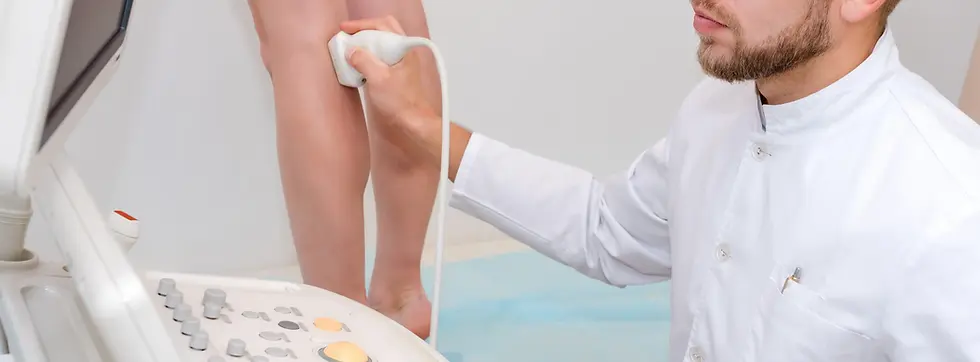
NICE guidance recommends duplex ultrasound to plan treatment for recurrent varicose veins, and endothermal ablation as the first option where a leaking trunk is found. Dr. Sohrabi's practice follows that guidance. The duplex ultrasound traces each vein to find where the new reflux begins. The work-up looks at every possible source: the veins feeding the recurrence, including perforators, a pelvic source, and veins left open by incomplete earlier treatment. Each source found is treated.
What it finds depends on the first treatment. A 2015 review of seven randomised trials found that after catheter ablation of the great saphenous vein, the commonest causes of recurrence were the treated vein reopening (32 per cent of recurrences) and a neighbouring vein, the anterior accessory saphenous vein, starting to leak (19 per cent). New vessel growth at the groin caused 2 per cent, against 18 per cent after traditional tie-and-strip surgery.
A Reopened or Newly Leaking Trunk: Closing It Again
When the scan shows a straight leaking trunk, whether a reopened segment, the other saphenous vein or the anterior accessory vein, it can usually be closed from inside with heat. In a 2011 UK series of 104 legs with recurrent varicose veins, laser ablation closed the target vein in 98 per cent. Symptom scores improved as much as after first-time treatment, with similar complication rates.
A partly reopened vein is not always a source. When the same group rescanned 27 partly reopened saphenous veins after laser ablation, most had shrunk and carried little or no reflux a year later; the three with significant reflux were treated again.
New Vessels at an Old Scar: Why Redo Groin Surgery Is Seldom First
After a junction has been tied and the vein stripped, fine new vessels can grow through the scar and reconnect the deep and surface veins, a process called neovascularisation. These vessels are thin and too twisted for a catheter to pass. Operating on the scarred groin again is possible, but in a UK series of 128 legs, complications followed 40 per cent of redo groin operations, most often lymph leaks and wound infection.
A review by vascular surgeons at Mayo Clinic notes that foam suits superficial, tortuous veins poorly suited to a catheter, as well as reopened segments of treated veins. Such recurrences are therefore usually treated with ultrasound-guided foam, explained in sclerotherapy for varicose veins, or removed through tiny incisions by phlebectomy. With no randomised trial on the question, a French review proposed foam first unless the scan shows an intact stump of the original vein with heavy reflux, where redo surgery
keeps a place.
Perforators, Side Branches and a Pelvic Source
Leaking perforator veins, the short connectors between the deep and surface systems, can be closed with a thermal catheter or with foam. In a 2016 US series of 296 perforator treatments, mostly in legs with skin damage or ulcers, closure at two weeks was 73 per cent with radiofrequency, 61 per cent with laser and 57 per cent with foam. A perforator found feeding the recurrence is treated along with the veins it feeds.
Leaking side branches are removed or injected, often at the same session as the trunk, as NICE suggests. When the new veins run from the vulva, the upper inner thigh or the back of the thigh, the source may sit in the pelvis, and pelvic imaging is added. Dr. Sohrabi follows 2022 European guidelines: without pelvic symptoms, the leg veins and the points where pelvic veins escape into the leg are treated first. With pelvic pain, or veins that came back soon after earlier treatment, he treats the pelvis first, closing the leaking veins from inside (embolisation), as explained in pelvic vein reflux.
What to Expect From a Second Round of Treatment
Treatment for recurrent veins usually improves symptoms, but expectations need adjusting. NICE asks specialists to explain that the chance of recurrence after treating recurrent varicose veins is higher than after a first treatment, and that more than one session may be needed. Cleveland Clinic notes that varicose veins are more likely to reappear with obesity, long hours of sitting and pregnancy after treatment, all within your control.
Every option carries risks. The NHS notes that pain and bruising can follow catheter closure, foam and surgery alike. After foam, Cleveland Clinic lists lumpy, firm veins for several months and brown marks that usually fade within three to six months, with infection, clots and inflammation as risks. Heat treatment of the small saphenous vein in the calf caused temporary numbness in 3 of 65 patients in a 2007 UK audit. Dr. Sohrabi scans the leg one week and one month after treatment to confirm that the target vein has closed and that the deep veins are clear.
Dr. Soroush Sohrabi is a UK-trained Consultant Vascular and Endovascular Surgeon (FRCS, CCT) practising in Dubai, with a Cleveland Clinic Advanced Endovascular Fellowship and 77 peer-reviewed publications.
Choosing a Surgeon for Recurrent Varicose Veins
Look for a surgeon who maps the leg again personally and offers catheter, foam and surgical options, so the plan follows the new pattern. Dr. Sohrabi performs and interprets his own duplex scans, offers thermal and non-thermal closure, foam sclerotherapy, phlebectomy and open surgery, and performs pelvic vein embolisation and iliac vein stenting himself. Book a consultation and bring any records from your earlier treatment.
About the Author
Dr. Soroush Sohrabi MD, PhD, FRCS, CCT (UK), PGCert, MCPhleb is a Consultant Vascular and Endovascular Surgeon practising in Dubai. He trained in the United Kingdom and holds a Fellowship of the Royal College of Surgeons (FRCS) in Vascular Surgery and a Certificate of Completion of Training (CCT). He has published 77 peer-reviewed papers with over 1,183 academic citations and is a member of the European Society for Vascular Surgery (ESVS) and the Vascular Society of Great Britain and Ireland (VSGBI). He is licensed by the UK General Medical Council (GMC No. 5207627) and the Dubai Health Authority (DHA No. 48905551).
Medically reviewed by Dr. Soroush Sohrabi MD, PhD, FRCS, CCT, Consultant Vascular and Endovascular Surgeon, October 2026.
References
National Institute for Health and Care Excellence. Varicose veins: diagnosis and management. NICE guideline CG168, Recommendations 1.1.2, 1.3.1 and 1.3.2. https://www.nice.org.uk/guidance/cg168/chapter/Recommendations
O'Donnell TF, Balk EM, Dermody M, Tangney E, Iafrati MD. Recurrence of varicose veins after endovenous ablation of the great saphenous vein in randomized trials. Journal of Vascular Surgery: Venous and Lymphatic Disorders. 2016;4(1):97-105 (published online 2015). https://doi.org/10.1016/j.jvsv.2014.11.004
Theivacumar NS, Gough MJ. Endovenous laser ablation (EVLA) to treat recurrent varicose veins. European Journal of Vascular and Endovascular Surgery. 2011;41(5):691-696. https://doi.org/10.1016/j.ejvs.2011.01.018
Theivacumar NS, Dellagrammaticas D, Darwood RJ, Mavor AID, Gough MJ. Fate of the great saphenous vein following endovenous laser ablation: does re-canalisation mean recurrence? European Journal of Vascular and Endovascular Surgery. 2008;36(2):211-215. https://doi.org/10.1016/j.ejvs.2008.03.014
Hayden A, Holdsworth J. Complications following re-exploration of the groin for recurrent varicose veins. Annals of the Royal College of Surgeons of England. 2001;83(4):272-273. PMID 11518377. https://pmc.ncbi.nlm.nih.gov/articles/PMC2503383/
Kalra M, Gloviczki P. Endovenous ablation of the saphenous vein. Perspectives in Vascular Surgery and Endovascular Therapy. 2008;20(4):371-380. https://doi.org/10.1177/1531003508328580
Perrin M, Gillet JL. Recurrent varices at the groin and popliteal fossa after surgical treatment [in French]. Journal des Maladies Vasculaires. 2006;31(5):236-246. https://doi.org/10.1016/s0398-0499(06)76622-7
Hager ES, Washington C, Steinmetz A, Wu T, Singh M, Dillavou E. Factors that influence perforator vein closure rates using radiofrequency ablation, laser ablation, or foam sclerotherapy. Journal of Vascular Surgery: Venous and Lymphatic Disorders. 2016;4(1):51-56. https://doi.org/10.1016/j.jvsv.2015.08.004
Theivacumar NS, Beale RJ, Mavor AID, Gough MJ. Initial experience in endovenous laser ablation (EVLA) of varicose veins due to small saphenous vein reflux. European Journal of Vascular and Endovascular Surgery. 2007;33(5):614-618. https://doi.org/10.1016/j.ejvs.2006.10.030
Cleveland Clinic. Varicose veins. https://my.clevelandclinic.org/health/diseases/4722-varicose-veins
Cleveland Clinic. Sclerotherapy. https://my.clevelandclinic.org/health/treatments/6763-sclerotherapy
NHS. Varicose veins. https://www.nhs.uk/conditions/varicose-veins/
De Maeseneer MG, Kakkos SK, Aherne T, et al. European Society for Vascular Surgery (ESVS) 2022 clinical practice guidelines on the management of chronic venous disease of the lower limbs. European Journal of Vascular and Endovascular Surgery. 2022;63(2):184-267. https://doi.org/10.1016/j.ejvs.2021.12.024