

Sclerotherapy in Dubai: What to Expect and the Results It Delivers

Updated: Aug 7
If you have noticed a web of fine red or blue veins spreading across your legs, you are far from alone. Spider veins and small varicose veins are among the most common vascular complaints seen in Dubai, where year-round heat, long hours on your feet, and the cultural calendar around summer travel make visible leg veins a source of real concern for many residents. Sclerotherapy remains one of the most established, non-surgical treatments available for these vessels, and for many patients a short clinic visit is all it takes to begin seeing results. If you have been searching for information on sclerotherapy in Dubai, this guide explains exactly how the procedure works, what a realistic outcome looks like, and why the clinical pathway to that outcome matters as much as the injection itself.
What Is Sclerotherapy?
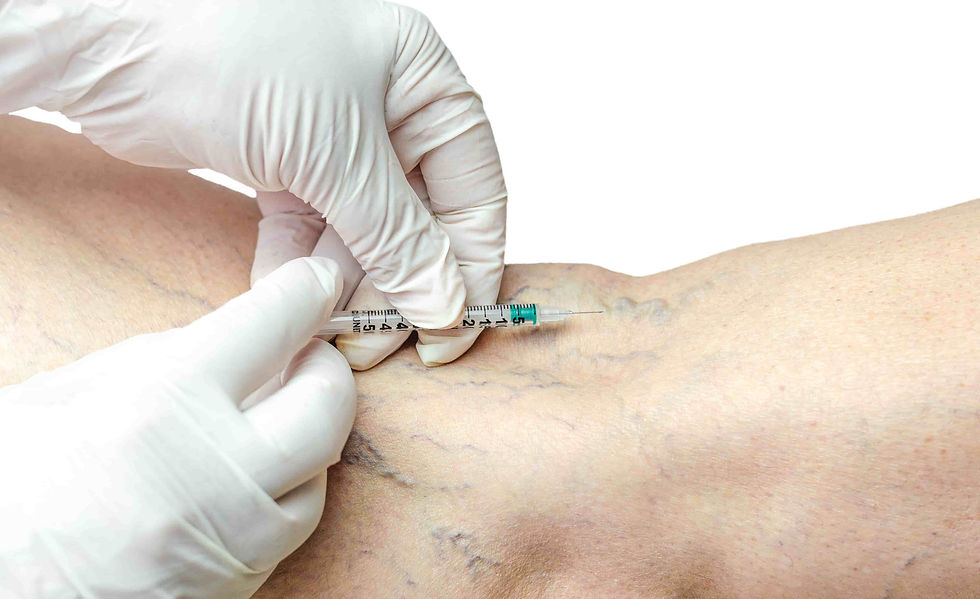
Sclerotherapy is a minimally invasive procedure in which a specially trained clinician injects a chemical solution directly into a targeted vein. The solution irritates the inner lining of the vessel, causing it to swell, seal shut, and gradually be reabsorbed by the body. Blood flow is redirected naturally through healthy veins nearby.
What Sclerotherapy Treats
Spider Veins
Spider veins (also called thread veins or telangiectasias) are tiny, dilated blood vessels visible at or just beneath the skin surface, typically appearing as red, blue, or purple branching lines on the legs, ankles, or feet. They are rarely dangerous but can cause itching or a burning sensation, and they represent a significant cosmetic concern for many patients in the UAE. The Cleveland Clinic notes that spider veins affect a large proportion of adults and are more prevalent in women, though men are also affected. Sclerotherapy is considered a first-line treatment for spider veins of suitable calibre according to the Cleveland Clinic.
Small Varicose Veins and Reticular Veins
Reticular veins are slightly larger, flat blue-green vessels that often feed the spider vein clusters visible on the skin. Small varicose veins, meaning those that are too narrow or tortuous for thermal ablation, may also be candidates for sclerotherapy. For larger, symptomatic varicose veins, a more comprehensive treatment approach is usually required, and this is discussed further below. Not every visible vein is appropriate for sclerotherapy; an accurate assessment is essential to determine which vessels can be safely and effectively treated.
How Sclerotherapy Is Performed
A standard liquid or foam sclerotherapy session follows a structured sequence. Ultrasound guidance may be used for deeper vessels.
Consultation and pre-procedure marking. The treating clinician examines your legs, identifies the target veins, and marks the injection sites. Photographs may be taken for comparison.
Patient positioning. You lie on an examination table, usually on your back with legs slightly elevated. No general anaesthetic is required.
Preparation of the sclerosant. The chosen agent, most commonly polidocanol or sodium tetradecyl sulphate (STS), is drawn up as a liquid solution or mixed with air to create a foam. Foam sclerotherapy increases the contact surface area between the agent and the vessel wall.
Injection into the target vein. Using a very fine needle, the clinician injects a small volume of sclerosant into each vessel. Multiple injections may be made in a single session.
Compression application. Immediately after the injections, a compression bandage or stocking is applied to maintain pressure on the treated veins and reduce the risk of blood pooling.
Post-procedure check. The clinician reviews the injection sites for any immediate reactions before you leave. The appointment typically lasts 30 to 45 minutes.
Discharge with written instructions. You are given guidance on walking, activity, and compression wear before leaving the clinic.
The NHS confirms that after foam sclerotherapy patients can usually return to most normal activities the same day as documented by the NHS.
What to Expect on the Day and Afterwards
On the day of treatment you should plan to walk gently for at least 15 to 30 minutes immediately afterwards, as movement encourages blood flow through the healthy veins and reduces the risk of thrombophlebitis in the treated segment. You should avoid strenuous exercise, swimming pools, hot baths, and direct sun exposure to the treated areas for at least 48 hours.
Compression stockings play an important role in the outcome. Depending on the vessels treated, you may be asked to wear them continuously for one to two weeks. Minor bruising, redness, and temporary dark staining along the treated vein are normal and should resolve over weeks to months.
One aspect that surprises many patients is that multiple sessions are often required. Larger clusters of spider veins or multiple reticular feeders typically need two to four treatment sessions spaced four to six weeks apart. This is not a sign that the procedure is not working; it reflects the anatomy of venous networks, where treating one area can unmask adjacent vessels that need attention.
Results: What Is Realistic
Most patients treated with sclerotherapy can expect a meaningful improvement in the appearance and any associated symptoms of their treated veins. High success rates for spider vein clearance are well documented in the clinical literature, and many patients achieve significant cosmetic improvement within three to six months of completing their course of sessions.
The timeline for fading is gradual. Larger vessels may take longer to be reabsorbed than finer ones, and in some cases a faint brown discolouration called haemosiderin staining can persist for several months before resolving. Very occasionally this discolouration is prolonged, and patients should be counselled about this before treatment.
It is equally important to understand what sclerotherapy does not do. It treats the specific vessels targeted during the procedure, but it does not prevent new veins from developing in the future. Genetic predisposition, pregnancy, prolonged standing, and other lifestyle factors all influence venous health over time. The goal of treatment is sustained cosmetic and symptomatic improvement, not a permanent guarantee against the development of new veins.
Sclerotherapy and the Importance of a Duplex Scan First
This is perhaps the most clinically significant point in this article, and one that separates a properly conducted vascular service from a purely cosmetic approach: before any sclerotherapy, underlying venous reflux must be assessed.
Spider veins and reticular veins visible on the skin surface are sometimes the outward expression of a deeper problem. If the valves in the great or small saphenous veins are incompetent, blood pools under pressure and pushes continuously against the surface vessels. Injecting these surface veins without addressing the underlying reflux is likely to produce poor results, early recurrence, and in some cases an increase in the burden of visible veins.
A duplex ultrasound scan is the standard investigation to map venous anatomy and identify reflux before treatment. The NHS notes that duplex ultrasound is typically performed before any intervention for varicose veins to plan the appropriate treatment. Where significant reflux is identified, the saphenous trunk should be treated first, using endothermal ablation or another appropriate technique, before proceeding to sclerotherapy for the residual surface vessels.
Any clinician offering sclerotherapy without first performing or reviewing a duplex scan is bypassing a step that directly affects both safety and outcome.
When to See a Specialist in Dubai
You should seek a specialist opinion if your veins are causing aching, heaviness, itching, or swelling, if you have noticed rapid progression, or if the appearance of your veins is affecting your confidence and daily life.
Dr. Soroush Sohrabi is a UK-trained Consultant General and Vascular Surgeon (FRCS, CCT) practising in Dubai, with a Cleveland Clinic Advanced Endovascular Fellowship and 77 peer-reviewed publications.
If you are ready to explore your options, arrange an assessment with Dr. Sohrabi's team to discuss whether sclerotherapy or another venous treatment is appropriate for you.
Why Choose Dr. Soroush Sohrabi for Sclerotherapy in Dubai
Selecting the right clinician for any venous procedure requires you to ask specific questions. Does the clinician hold a recognised specialist qualification in vascular surgery? Are they trained to perform and interpret duplex ultrasound? Do they have access to the full range of venous treatments, including thermal ablation and open surgery, so that they are not limited to a single technique? And is the procedure performed within a hospital environment with the infrastructure to manage any complication?
Dr. Soroush Sohrabi meets each of these criteria. He holds the Fellowship of the Royal College of Surgeons (FRCS) in Vascular Surgery and a Certificate of Completion of Training from the United Kingdom, with additional advanced endovascular training at the Cleveland Clinic in the United States. His practice in Dubai provides the full diagnostic and procedural infrastructure of a tertiary hospital, including duplex ultrasound, theatre facilities, and specialist nursing support.
The European Society for Vascular Surgery, whose clinical practice guidelines represent the benchmark for vascular care in the UK and Europe, emphasises that venous treatment should be individualised, anatomy-guided, and delivered by trained vascular specialists. Dr. Sohrabi's service reflects this standard: sclerotherapy is offered as part of a full venous pathway, not in isolation.
This integrated, consultant-led approach in Dubai distinguishes his practice from standalone cosmetic vein clinics. When you are seen by Dr. Sohrabi, you are assessed as a vascular patient, not solely as a cosmetic case, which means the full clinical picture is considered from the outset.
For the finest thread veins, read about micro sclerotherapy, and see our step-by-step guide to a sclerotherapy session for spider veins.
Frequently Asked Questions
How many sclerotherapy sessions will I need?
The number of sessions depends on the number, size, and distribution of the veins being treated. Most patients require between two and four sessions spaced four to six weeks apart. Your clinician will give you a more precise estimate after your initial assessment.
Is sclerotherapy painful?
Most patients describe a mild stinging or burning sensation during the injections, which fades within a few minutes. The needles used are very fine and no anaesthetic injection is required. Most people tolerate the procedure comfortably and return to work the same day.
How long does it take to see results after sclerotherapy?
Smaller spider veins often begin to fade within three to six weeks. Larger reticular veins may take up to three to four months to be fully reabsorbed. Some temporary discolouration can persist for longer, but this usually resolves over time.
Are the results of sclerotherapy permanent?
Sclerotherapy permanently destroys the treated vessels, which do not reopen. However, new spider veins can develop over time due to genetic factors, lifestyle, or pregnancy. The procedure delivers lasting improvement to the specific veins treated, not lifelong immunity from future vein development.
Can I exercise after sclerotherapy?
Gentle walking is encouraged immediately after treatment. Strenuous exercise, running, heavy weights, and swimming should be avoided for at least 48 hours, and sometimes longer depending on the vessels treated. Your clinician will give you specific post-procedure guidance.
Is sclerotherapy suitable for everyone?
Sclerotherapy is not appropriate for pregnant women, patients with certain clotting disorders, those with significant arterial disease in the legs, or patients with active skin infections over the treatment area. A thorough clinical assessment, including a duplex ultrasound scan, is required before any treatment to confirm suitability.
Key Takeaways
Sclerotherapy is an established, non-surgical treatment for spider veins and small varicose veins that works by injecting a sclerosant agent to seal and resorb the targeted vessel.
The Cleveland Clinic recognises sclerotherapy as a first-line treatment for spider veins of appropriate calibre, with high success rates reported in clinical practice.
The NHS confirms that patients can return to most normal daily activities on the day of foam sclerotherapy, making it a convenient option for working professionals in Dubai.
A duplex ultrasound scan should be performed before any sclerotherapy to exclude underlying venous reflux, which, if untreated, will lead to poor results and early recurrence.
Multiple sessions are frequently needed, as most patients with spider vein clusters require two to four treatment appointments spaced four to six weeks apart.
Results are gradual, with smaller veins typically fading within three to six weeks and larger vessels taking up to three to four months; haemosiderin staining may persist longer in some patients.
Sclerotherapy delivers meaningful, lasting cosmetic and symptomatic improvement to the treated vessels, but does not prevent new veins from forming over time due to underlying genetic or lifestyle factors.
About the Author
Dr. Soroush Sohrabi MD, PhD, FRCS, CCT is a Consultant General and Vascular Surgeon in Dubai. He trained in the United Kingdom, holds the FRCS in Vascular Surgery and a CCT, completed an advanced endovascular fellowship at the Cleveland Clinic, USA, and has published 77 peer-reviewed papers with over 1,183 academic citations. He is licensed by the UK GMC and the Dubai Health Authority.

